
 Price
Price
 Motor (Nominal)
 Range
Range
 Battery
Technical Architecture
Overview

Price
$1,599
MSRP

Motor
500 W
Nominal Output

Battery
624 Wh
Battery Capacity

Speed
20 mph
Unlocked Top Speed

Payload
330 lbs
Max Load Capacity

Safety Standards
UL 2849 Certified
Electrical System Integrity
UL 2711 Certified
Battery Performance & Safety

Foldable
No
Frame Style Not Specified
Editorial Insights
Key Benefits & Drawbacks
Reasons to Buy
- Bold, moto-inspired design appeals heavily to younger demographics.
- Long bench seat allows for changing riding positions or carrying a passenger.
- Dual-battery options provide massive range for exploring the city.
Reasons to Avoid
- Fixed seat height prevents proper leg extension for efficient pedaling.
- Heavy construction makes lifting the bike difficult.
Expert Verdict
In-Depth Analysis
Editorial Review: Evaluating theX7 Dual
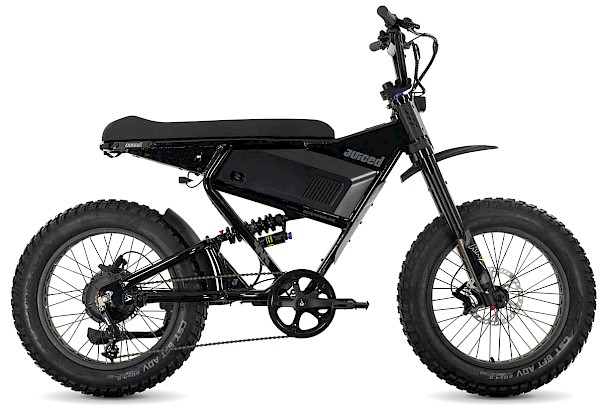
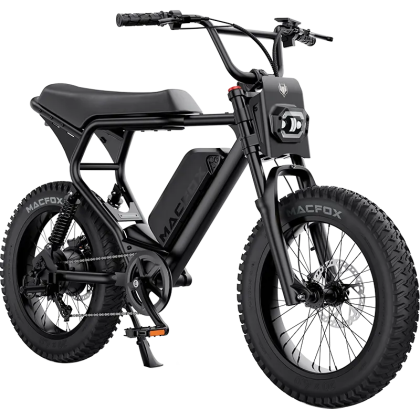
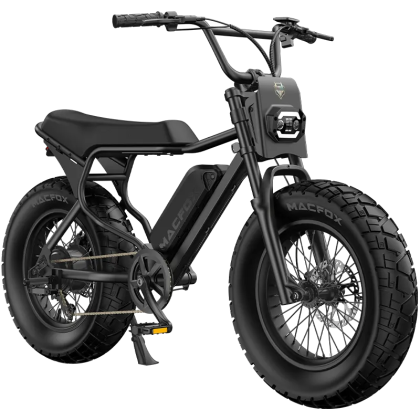
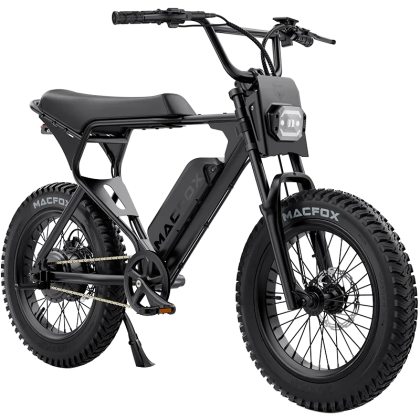
The Macfox X7 Dual Battery model (or the X7 outftted with Macfox’s official plug-and-play Dual Battery Upgrade Kit) takes the rugged, mini-moto aesthetic of the base scrambler and transforms it into a long-range weekend cruiser.
Because the base X7 is built on a heavy, high-carbon steel frame and rolls on incredibly wide, high-friction fat tires, it naturally demands a lot of juice. By adding a second matching battery pack mounted directly onto the frame, Macfox effectively doubles the fuel tank. This completely eliminates range anxiety, allowing riders to treat this single-speed moped less like a neighborhood plaything and more like a dependable, long-range commuter or all-day trail explorer.
The Technical Snapshot
- The Dual-Battery System: Connects two removable, lockable 48V 13Ah (624Wh each) packs to create a massive 1,248Wh dual-energy ecosystem. The bike utilizes an intelligent battery management system that draws power seamlessly between both packs, extending your real-world range from 30 miles up to a substantial 60 to 70 miles per charge.
- Power & Acceleration: Driven by a 500W nominal rear hub motor that peaks at 750W. It provides plenty of low-end torque for quick off-the-line launches and light trail hill climbs, managed via a right-hand thumb throttle or 5 levels of pedal assist.
- Speed & E-Bike Class: Arrives restricted to legal Class 2 settings, capping out at 20 mph on pure throttle. However, the backlit LCD dashboard easily allows riders to unlock the speed limit, allowing the motor to run wide open up to a swift 25 mph.
- The Moto Fat-Tire Stance: Keeps the signature, ultra-wide asymmetrical tire footprint. It rolls on a beefy 20x4.5-inch front tire paired with a massive 20x5.0-inch rear fat tire. This heavy-duty rubber gives the bike an incredibly stable, planted feel when carving tight corners or gliding through loose gravel and sand.
- Brakes & Front Cushioning: Upgraded to high-leverage hydraulic disc brakes that offer feather-light, instant stopping control—a critical upgrade for handling the extra weight of a dual-battery setup. Up front, a lockable hydraulic suspension fork takes the bite out of curb drops and rough pavement.
- Gearing & Single-Speed Simplicity: Operates on a single-speed mechanical drivetrain complete with a custom gold chain. This means there are zero delicate derailleurs to break, smash on a rock, or index, creating a virtually zero-maintenance "twist-and-go" riding experience.
- Frame, Weight, & Sizing Options: Built around a heavy-duty steel frame featuring a long, 24-inch extended moped saddle. Because of the steel build and dual batteries, it is a heavy machine, scaling in at roughly 95 pounds, while supporting a 330-pound maximum load capacity.
Single vs. Dual Battery Comparison
|
Feature Metric |
Single Battery X7 |
Dual Battery X7 |
|
Total Battery Capacity |
624Wh (48V 13Ah) |
1,248Wh (Two 48V 13Ah packs) |
|
Real-World Range |
30 to 35 miles |
60 to 70 miles |
|
Estimated Total Weight |
~87 lbs |
~95 lbs |
|
Charging Routine |
Single Charger (5-6 hours) |
Dual Charging required |
Sizing Reminder: Just like the base model, the fixed moped saddle means you cannot adjust the seat height (30 inches). The standard X7 frame is best optimized for riders from 4'11" to 5'9". If you are taller, you will want to look specifically for the Macfox X7L Dual Battery model, which extends the frame to comfortably fit riders from 5'3" to 6'6".
Key Specifications
X7 Dual
Performance
- Motor (Nominal)
- 500 W
- Motor (Peak)
- 750 W
- Battery
- 624 Wh
- Battery (Ah)
- 13.0 Ah
- Range
- 70 mi
- Top Speed
- 20 mph
Practicality
- Price
- $1,599
- Weight
- 87 lbs
- Payload Capacity
- 330 lbs
- Foldable
- No
Real-World Range Estimator
Fine-tuned for the 624 Wh High-Capacity Battery
30.0 mi
Motor Type
Terrain Profile
The Science of eBike Range
Estimated range is total usable battery capacity divided by adjusted energy consumption: Range (mi) = Battery (Wh) ÷ Adjusted Consumption (Wh/mi). Manufacturer range claims are measured in ideal lab conditions, so this model starts from a real-world baseline and applies a multiplier for each factor you change above.
The variables
- Baseline: 20 Wh per mile, for a 180 lb rider on flat ground using standard assist with a hub motor. Every adjustment below is a multiplier against that number.
- PAS level: assist is banded rather than linear, because a controller delivers set power steps rather than a smooth ramp. Levels 1–2 draw 30% less energy than standard, level 4 draws 30% more, and level 5 draws 60% more — the jump at the top is steep because aerodynamic drag rises with the square of speed.
- Motor type: mid-drive motors run through the gearing, so they hold a more efficient operating range under load and consume roughly 14% less energy than a hub motor over the same route. Hub motors lose more to heat when they bog down on climbs.
- Rider weight: consumption rises 5% for every full 20 lbs over the 180 lb baseline, reflecting the extra rolling resistance and the energy lost accelerating more mass back up to speed.
- Terrain: a hilly profile adds 30% over flat ground. Regenerative braking recovers very little of what a climb costs, so elevation is close to a straight energy penalty.
This estimate is independent of the Range score shown in the rating breakdown, which grades the model against the rest of the catalogue rather than predicting a single ride. Treat the figure as a planning guide — tyre pressure, wind, temperature and stop-start riding all move the real number.
You May Also Like
Similar Models